Now Reading: iPhone X Charging Port Flex Replacement Guide
-
01
iPhone X Charging Port Flex Replacement Guide
iPhone X Charging Port Flex Replacement Guide
If your iPhone X is not charging properly, disconnects frequently, or fails to connect to a computer, the charging port flex cable may be damaged. Daily wear, dust buildup, liquid exposure, or cable strain can cause charging port failure over time.
In this guide, we’ll show you how to replace the charging port flex on the iPhone X, step by step, using the correct tools and safe repair practices. This is a detailed repair that involves removing multiple internal components, so follow the steps carefully.
Reasons to Replace the iPhone X Charging Port Flex
- iPhone X not charging or charging intermittently
- Loose charging cable connection
- Device not detected by computer
- Charging works only at a certain angle
- Corrosion or liquid damage near the charging port
- Microphone or antenna issues linked to the charging flex
Repair Difficulty
Difficulty Level: ⭐⭐⭐⭐☆ (Advanced)
This is an advanced repair involving full disassembly, logic board removal, and careful cable handling.
Estimated Repair Time: 60–90 minutes
Recommended For: Experienced DIY repair technicians
Compatibility and Model Numbers
This repair guide based on iPhone X mobile phone.
Compatible Mode Numbers | A1865, A1901, A1902, A1903
Tools You Need
- Heating pad / heat gun / hairdryer
- Suction cup
- Plastic card pry tools / opening picks
- Phillips PH000 screwdriver
- Pentalobe P2 Screwdriver (for bottom screws)
- Tri-Point Y000 Screwdriver
- Adhesive (B7000 or double-sided frame adhesive)
- Bonding clips or rubber bands (optional but recommended)
Make sure the device is turned off and the SIM tray is removed before starting.
How to Find Tools and Parts
- Heating pad – https://amzn.to/3H0tHzJ
- Portable Heat Gun – https://amzn.to/4mszih1
- Clamps https://amzn.to/3GYJT4w
- STREBITO 142 Piece Repair Tool Kit https://amzn.to/3UO1jUx
- Glue | Adhesive https://amzn.to/46exVxe
- Compatible Parts –
- Battery – https://amzn.to/4fI15YG
- Screen – https://amzn.to/3VIu2KN
- Other Parts – https://amzn.to/4n2vPq4
- Silicone Work Repair Mat https://amzn.to/45Emz5l
Protect Your iPhone X
- 2 in 1 Protection https://amzn.to/46apLVC
iPhone X Charging Port Flex Replacement – Step-by-Step Instructions
Step 1: Power Off and Remove SIM Tray
Turn off the iPhone X completely. Remove the SIM tray using a SIM ejector tool.
Step 2: Remove Bottom Screws
Using a pentalobe screwdriver, remove the two screws next to the charging port.
Step 3: Open the Display Assembly
Attach a suction cup near the bottom of the screen and gently lift to create a gap.
Insert a plastic card or triangle pick and carefully separate the display from the frame, loosening the rubber gasket around the edges.
Step 4: Open the Screen
Lift the screen from the left side like opening a book.
Remove five screws securing the metal protector shield and take the shield off.
Step 5: Disconnect Display and Battery
Disconnect the following connectors:
- Battery connector
- Touch connector
- LCD connector
- Front camera and earpiece assembly connector
Remove the LCD unit and set it aside.
Step 6: Remove Antenna Bracket
At the bottom of the phone, remove the antenna bracket by undoing seven screws and disconnecting the antenna plug.
Step 7: Remove Speaker and Taptic Engine
Disconnect the connector, remove the speaker buzzer, and lift out the Taptic Engine after unplugging it.
Step 8: Remove the Battery
Peel out the three battery adhesive strips—one at the top and two at the bottom—slowly using fingers or tweezers.
Lift and remove the battery.
Step 9: Disconnect Logic Board Connectors
Disconnect nine connector plugs securing the logic board.
Remove the front face camera unit from the board.
Step 10: Remove the Logic Board
Disconnect one final plug and remove four screws securing the logic board.
Gently move aside cables and lift the board out carefully.
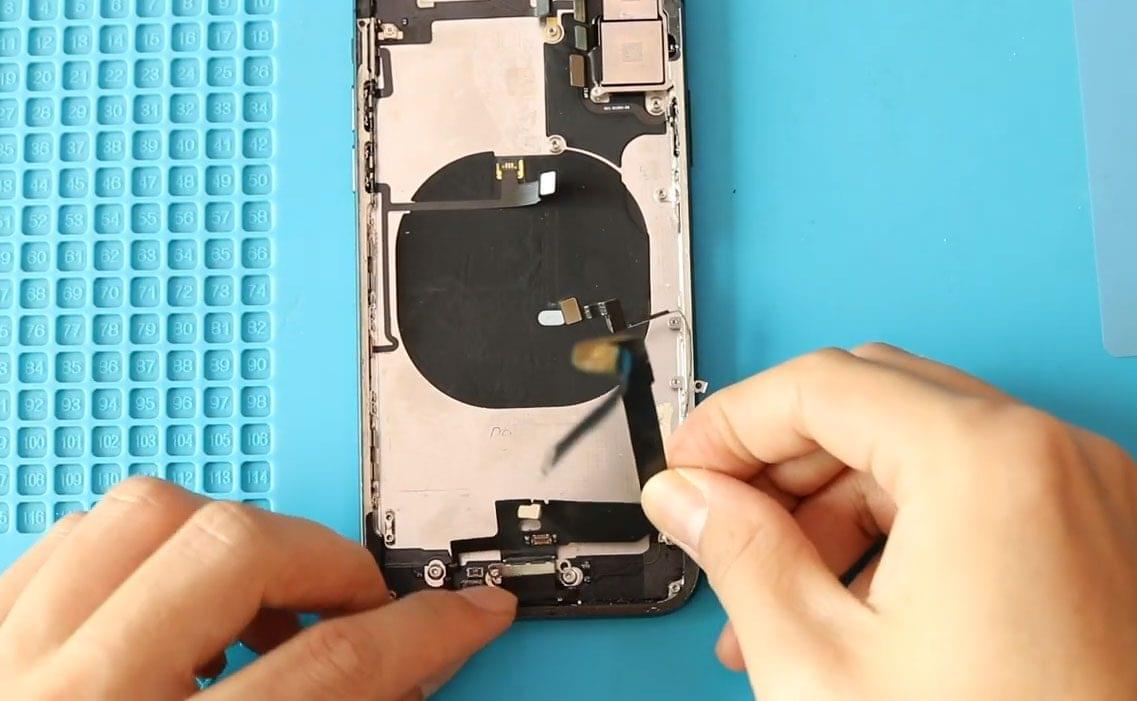
Step 11: Remove the Charging Port Flex
Undo three screws securing the charging port bracket and remove it.
Remove two additional screws holding the charging port flex.
Gently peel the charging port cable from the frame and remove it.
Step 12: Install the New Charging Port Flex
Place the new charging port flex into position.
Secure it with four screws, then reinstall the bracket and secure it with its screw.
Step 13: Reinstall Logic Board and Components
Place the logic board back into position and secure it using four screws.
Reconnect all required connectors.
Reinstall:
- Taptic Engine and secure its plug
- Speaker buzzer and connector
- Speaker connector bracket
- Antenna bracket (connect plug and secure six screws)
Step 14: Reconnect Cameras and Battery
Reconnect seven logic board connectors.
Install the front camera and connect its three connectors.
Place the battery with new adhesive strips.
Step 15: Apply Water Seal and Reconnect Display
Apply the pre-cut water seal adhesive to the frame.
Note: This does not fully restore original water resistance.
Reconnect the battery connector.
Reconnect the LCD, touch, and earpiece assembly connectors.
Secure the metal shield using five screws.
Step 16: Close the Phone
Align the top of the display first, then press along the sides and bottom evenly.
Apply firm pressure along the frame edges.
Reinsert the SIM tray and tighten the two bottom screws.
Frequently Asked Questions (FAQ)
Q1: Does replacing the charging port delete data?
No, this repair does not affect your data. However, backing up your device is recommended.
Q2: Why is the charging port replacement so complex?
The charging port flex is connected to multiple components, including antennas and microphones, requiring full disassembly.
Q3: Can I replace just the port without removing the logic board?
No, the logic board must be removed to access and replace the charging port flex safely.
Q4: Will water resistance be restored after repair?
No, even with a new seal, water resistance cannot be fully guaranteed.
Troubleshooting (After The Repair)
Q: iPhone X still doesn’t charge after replacement.
Check the charging port connector and ensure all logic board plugs are properly seated.
Q: No sound or microphone not working.
Ensure the charging port flex and antenna connectors are properly connected.
Q: Phone won’t turn on after reassembly.
Reconnect the battery and display connectors and verify the logic board is correctly positioned.
Q: Display not responding after repair.
Check the LCD and touch connectors and confirm the metal shield is installed correctly.
Conclusion
Replacing the charging port flex on the iPhone X is an advanced but effective repair that can restore charging, connectivity, and microphone functionality. With patience, proper tools, and careful handling, this repair can be completed successfully.
If you have any questions, feel free to leave a comment. Happy repairing!
Repair Guides